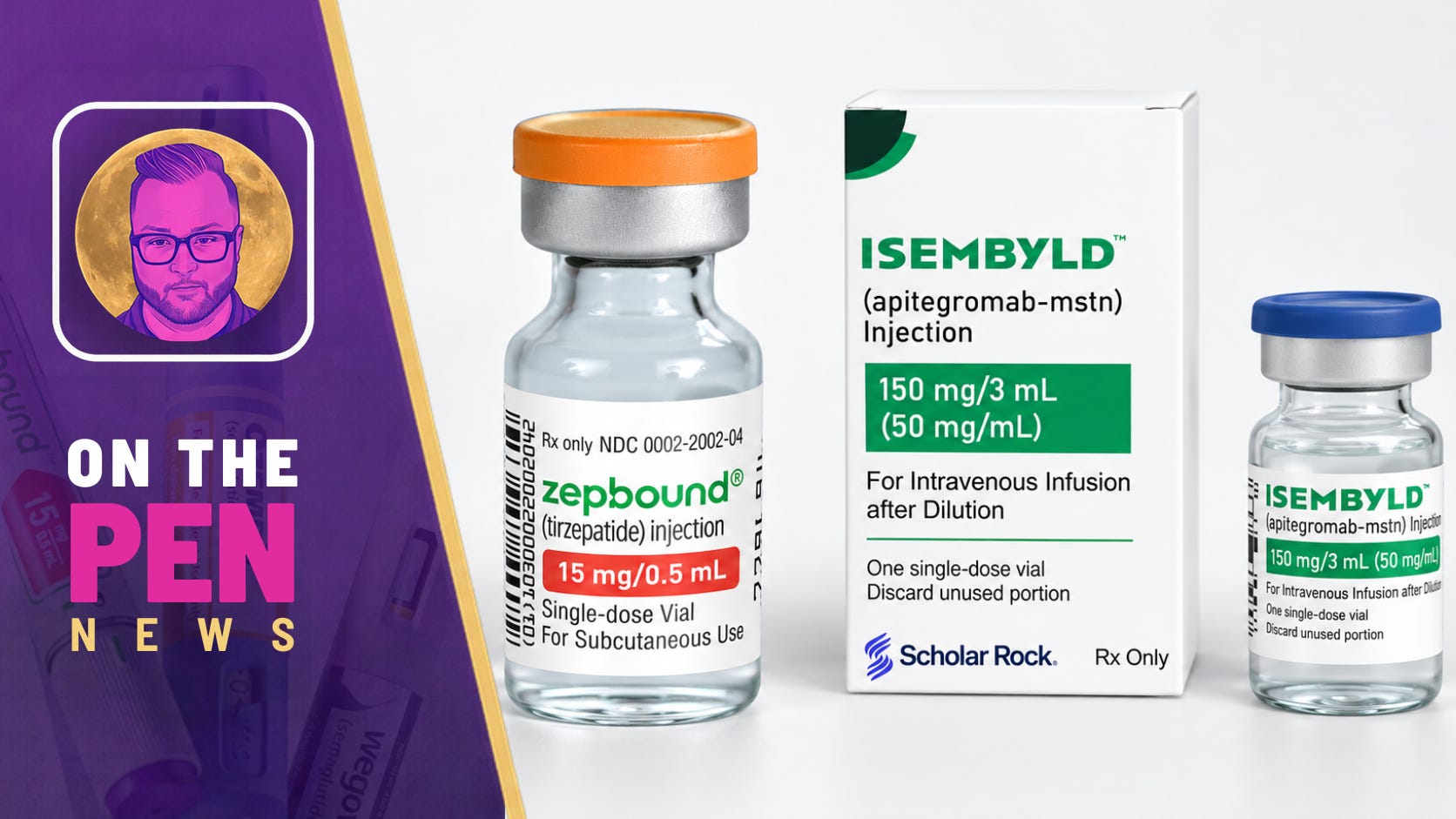
If you take Zepbound or Mounjaro, you may eventually have access to treatments specifically designed to help preserve muscle while you lose weight. And you may already be hearing from your favorite GLP-1 influencer that the FDA just approved apitegromab, now sold as ISEMBYLD, the latest muscle-targeting drug to reach the market.

Here’s the catch: the approval was for spinal muscular atrophy, not obesity. Apitegromab has separately been studied as a companion to tirzepatide, and the early results suggest it can substantially reduce the amount of lean mass lost during treatment. But that does not mean Zepbound users can easily add ISEMBYLD today. Its use for obesity would be off label, it is delivered by IV infusion, and access to a newly approved biologic outside its FDA-approved indication would likely be nearly impossible, not to mention extremely expensive.

Still, the research points toward a shift we’ve been highlighting for years. Future obesity treatments may focus not just on how much weight people lose, but on the quality of that weight loss, including how much fat disappears and how much lean tissue is preserved along the way.

Tirzepatide Plus a Muscle-Targeted Biologic

In the Phase 2 EMBRAZE trial, 102 adults with overweight or obesity received tirzepatide alongside either apitegromab or placebo. After 24 weeks, total weight loss was fairly similar, but participants receiving apitegromab lost 1.6 kilograms of lean mass compared with 3.5 kilograms in the placebo group, representing about 55% greater lean-mass retention.

That’s an encouraging early signal, but lean mass and skeletal muscle are not interchangeable terms. Lean mass measured by DXA includes muscle along with organs, water and other non-fat tissues, and this relatively short trial does not establish that adding apitegromab produces better strength, physical function or long-term outcomes.

For the On The Pen community, ISEMBYLD also isn’t a realistic obesity adjunct option today. Off-label use doesn’t scare most of us. The price tag probably will.

Scholar Rock has not announced a commercial price that I could verify yet, but ISEMBYLD is a fully human monoclonal antibody given by IV infusion every four weeks in the obesity study. Even if a physician were willing to prescribe it off label, insurance coverage outside spinal muscular atrophy could be difficult to obtain, leaving a potentially enormous access problem for patients.

Lilly May Already Have the More Realistic Version

The more practical obesity story may be bimagrumab, another monoclonal antibody that Eli Lilly acquired through its 2023 purchase of Versanis Bio for up to $1.925 billion. At the time, Lilly specifically said combining its incretin portfolio, including tirzepatide, with an activin receptor blocker like bimagrumab could represent the next major step in obesity treatment.

We’ve now seen why Lilly was interested. In the Phase 2 BELIEVE trial, bimagrumab plus semaglutide produced substantially greater fat-mass reductions while preserving far more lean mass than semaglutide alone. At 72 weeks, the high-dose combination reduced total body fat mass by 45.7%, while about 92% of the weight lost came from fat.

Unlike apitegromab, Lilly is already developing bimagrumab specifically within obesity. An ongoing Phase 2 study is testing bimagrumab and tirzepatide alone and in combination, with endpoints examining body weight, total fat mass, visceral fat and lean mass. The study completed its primary 24-week period in January, but results have not yet been posted publicly, and follow-up is expected to continue into January 2027.

Then there is retatrutide. Lilly has not announced a bimagrumab plus retatrutide clinical trial (though they have alluded to the potential in earnings calls), so we should avoid getting too far ahead of the evidence, but it owns both assets. If bimagrumab can meaningfully alter body composition alongside tirzepatide, pairing that biology with an even more potent next-generation incretin becomes an obvious question for researchers to ask.

Patient Takeaways

If you’re taking a GLP-1, I wouldn’t interpret the ISEMBYLD approval as a reason to start hunting for apitegromab. It isn’t approved for obesity, access would likely be difficult, IV administration is burdensome, and the evidence we have so far comes from a small Phase 2 proof-of-concept study.

What patients should pay attention to is the strategy behind it. The obesity drug race is beginning to move beyond asking how much weight a medication can make someone lose and toward asking what kind of weight is being lost.

Apitegromab provides one intriguing proof of concept. Bimagrumab may provide the more realistic obesity pathway because Lilly is already testing it directly with tirzepatide.

The next era of obesity medicine may not simply produce a bigger number on the weight-loss chart. It may allow patients to lose enormous amounts of fat while preserving substantially more lean tissue and, eventually, hopefully translating that into better strength, function and long-term health.

That’s the promise here: not simply more weight loss, but better weight loss.