The On The Pen community has spent a lot of time talking about how effective the Wegovy Pill has been at expanding the GLP-1 market, but the lesser asked question for those on the pen is: would you switch?
Especially for those who are paying cash for their GLP-1, would you trade your weekly injection for a daily pill? For some, it’s simple economics. The pills are cheaper. Now we have some real-world data (presented at EASD 2026) which suggests that may be a viable option for at least some patients, and I really want to know what our community thinks about it.
The first real-world look at switching from shots to the Wegovy pill
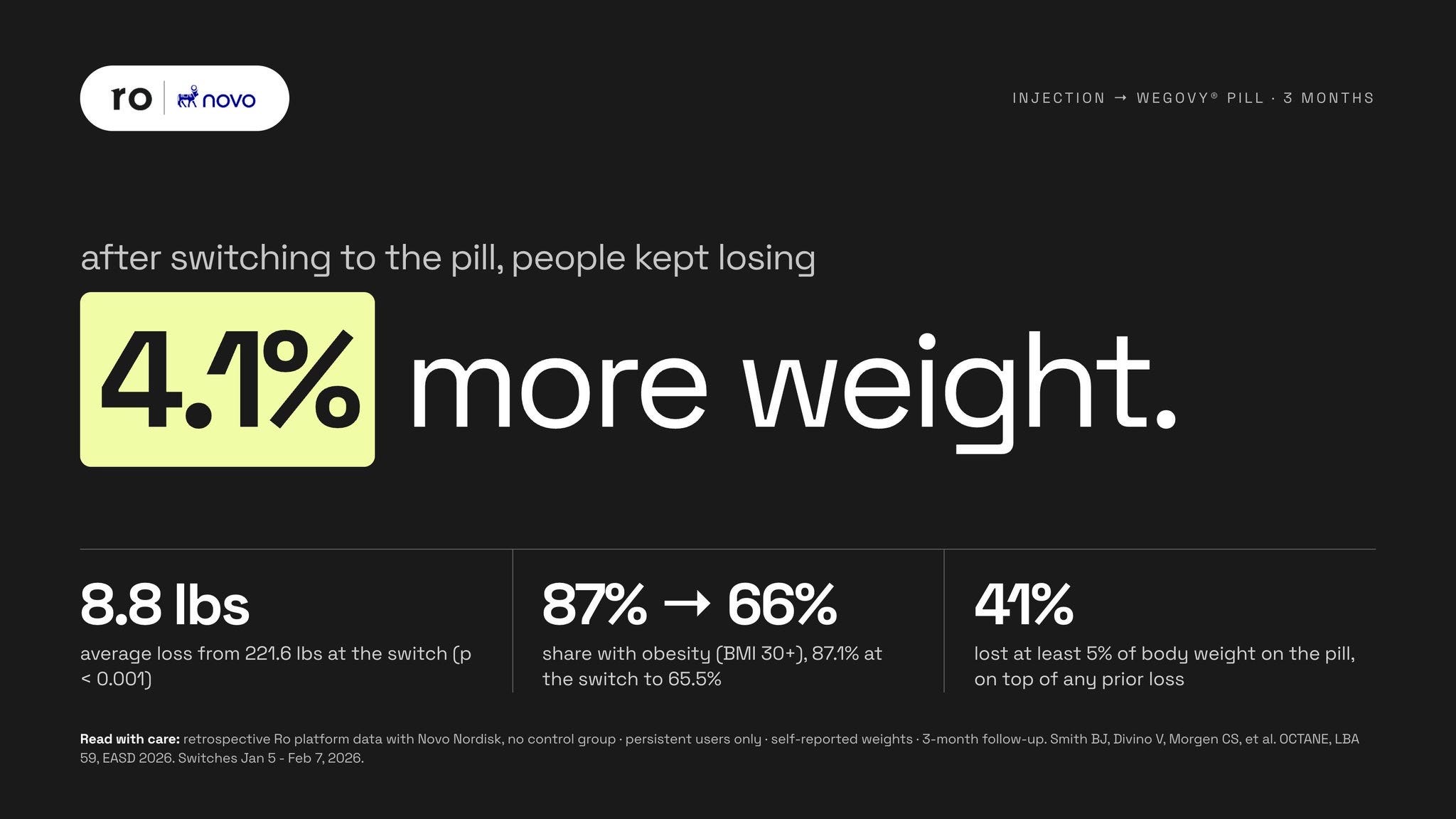
Novo Nordisk and Ro presented new data from the OCTANE study looking at 194 adults who switched from injectable semaglutide or tirzepatide to oral semaglutide, the Wegovy pill. After three months on the pill, participants lost an average of 4.1% of their body weight, or about 8.8 pounds based on an average starting weight of roughly 222 pounds. About 41% of participants lost at least 5% of their body weight, while the percentage meeting the clinical definition of obesity, a BMI of 30 or higher, fell from 87.1% to 65.5%.

What makes this data especially intriguing for our community is that these were not people who were just starting GLP-1 treatment for the first time. They were already taking injectable semaglutide or tirzepatide and then moved to the pill, which raises a different question than the one we have been asking about oral GLP-1s for years.
Much of the conversation around pills has centered on expanding the market to people who hate needles, travel often, or simply prefer the convenience of a tablet. OCTANE raises the possibility that pills may not only serve as a gateway into GLP-1 treatment, but also as another path within treatment for people who are already established on injections.
If that seems like a far off proposition, it’s not. Yeah, advent of modern obesity medicine meant early choices were extremely limited, but managing chronic disease rarely looks like picking one medication and staying on it forever. Highly effective pill options now present an entirely new pathway for patients.
This is where obesity care starts becoming more personalized
People change, insurance changes, finances change, side effects change, and life changes. A person may love a weekly injection today and want something completely different two years from now. Someone else may start with a pill and eventually decide they want the convenience or effectiveness of a weekly injection, while others may need to move between medications because of affordability, tolerability, availability, or personal preference.
This is why I think the next era of obesity medicine becomes much less about asking which drug “wins” and much more about asking which treatment makes sense for a particular patient at a particular point in their life.
That is a much more patient-centered way to think about obesity care, and it is one reason real-world studies like this matter. Clinical trials tell us what can happen under controlled conditions, while real-world evidence starts telling us what happens when people have jobs, families, travel schedules, insurance problems, side effects, preferences, fears, and everything else that comes with actual life.
Among participants in OCTANE with available survey data, most reported at least one treatment improvement after switching. Roughly 69% said their clothes fit better, and about 51% reported healthier eating.
While the data certainly fall short of proving the Wegovy Pill is on par with injectables at higher doses, it does show that for some patients, moving from an injection to oral semaglutide does not have to mean giving up progress.
There are some important caveats
This was a relatively small real-world analysis of 194 patients, not a randomized clinical trial, and patients had to remain on oral semaglutide for the full three-month follow-up period to be included. That could introduce selection bias because people who stopped early due to side effects, lack of effectiveness, cost, or preference may be underrepresented.
Weights were also self-reported, and patients were not required to have been on their previous injectable medication for any specific amount of time or to have lost weight on it before switching. The average time between their last injectable prescription and starting oral semaglutide was about 37 days.
That means this study does not answer one of the questions I suspect many people are already wondering about: what happens if someone has been on high-dose tirzepatide for two years, has completely plateaued, and then switches directly to the Wegovy pill? We do not know yet, but this would make for an excellent RCT. This is exactly the kind of question I want more real-world research to explore, because obesity is incredibly variable.
Patient takeaway
More options are good, not because every new drug has to beat everything that came before it, and not because every patient needs the highest possible percentage of weight loss, but because obesity is a chronic and multifactorial disease. Patients deserve more than one road.
For some people, the injection may remain the easiest and most effective option. For others, a pill could eventually be cheaper, simpler, more comfortable, or simply fit their life better. Now we have an early signal that patients may be able to move from one to the other and continue making progress.
That brings me back to the question I really want to ask all of you: if you are currently taking an injectable GLP-1, would you ever consider switching to a pill?
Would cost make you switch? Would needle fatigue, travel, side effects, or convenience matter more? Or would you rather stay with the injection as long as it is working?
If you have already thought about switching, I would especially like to know what is holding you back.
Drop your answer in the comments. I suspect the patient perspective here may end up being just as interesting as the data itself.