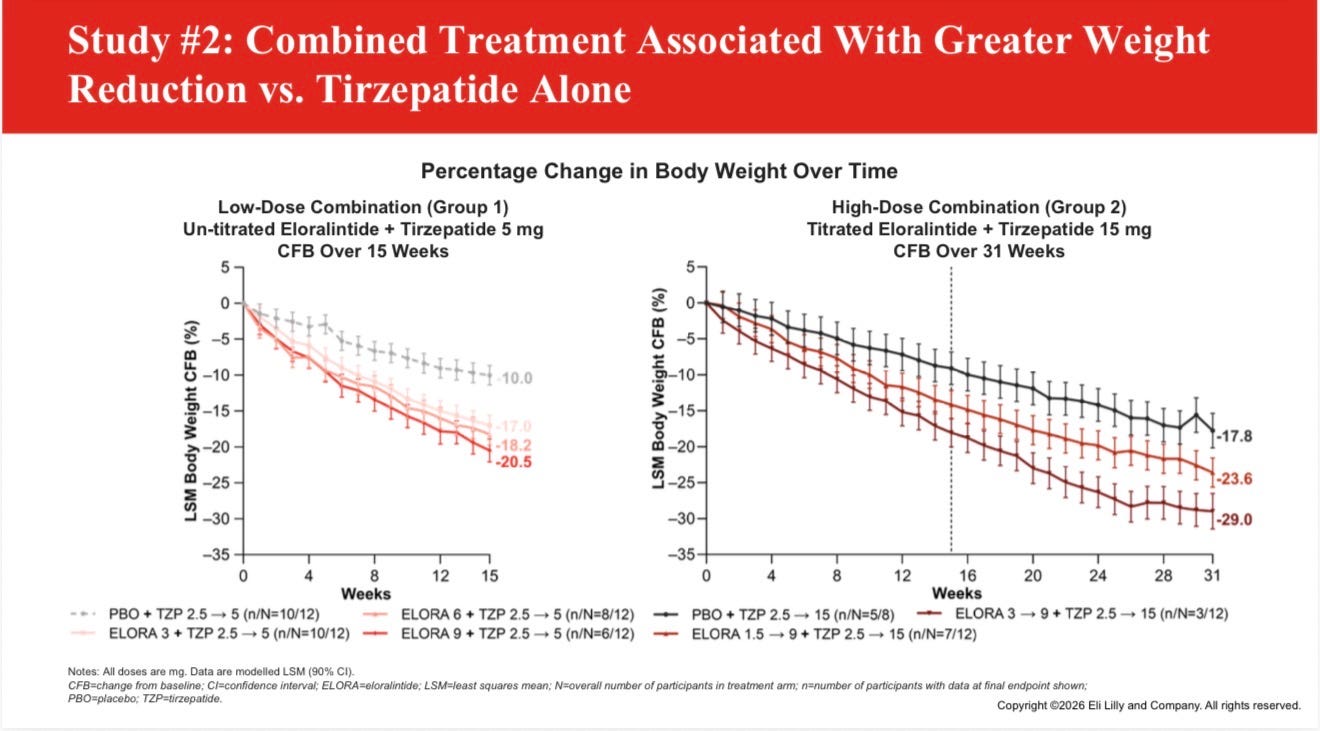
Eli Lilly just put another number on the board that is going to get a lot of attention in obesity medicine: 29% average weight loss at Week 31 with a combination of tirzepatide and the selective amylin receptor agonist eloralintide. In the same Phase 1b study, tirzepatide 15 mg alone produced roughly 17.8% weight loss over the same period.
The comparison that makes the result even more noteworthy is retatrutide. In Lilly’s Phase 3 TRIUMPH-1 trial, retatrutide 12 mg produced 28.3% average weight loss at 80 weeks using the efficacy estimand. These are not directly comparable studies, but numerically, the tirzepatide-eloralintide combination reached a slightly higher average weight-loss in fewer weeks than retatrutide did in 80, and just under the ~30% number reporter in the 104 week extension.
ON THE PEN is a reader-supported publication. To receive new posts and support my work, consider becoming a free or paid subscriber.
That doesn’t mean the combination has definitively “beaten” retatrutide. It does mean Lilly has produced another efficacy signal near the 30% threshold, this time in just 31 weeks, by adding an amylin drug to tirzepatide rather than building all of the activity into a single molecule.

Lilly is testing what comes after “maxed out”
Eloralintide, formerly LY3841136, is Lilly’s selective, long-acting amylin-1 receptor agonist. Tirzepatide activates the GIP and GLP-1 receptors, while eloralintide brings in a different hormonal system involved in appetite and satiety. Lilly has previously reported dose-dependent weight reduction of up to 20% at 48 weeks with eloralintide alone.
The new studies looked at what happens when those mechanisms are combined. Lilly tested several dose combinations in adults with overweight or obesity without type 2 diabetes, including a high-dose regimen targeting 9 mg of eloralintide and 15 mg of tirzepatide.
The efficacy signal was consistent across the program. In Study 1, the combination produced greater weight reduction than either eloralintide or tirzepatide alone. In Study 2, the high-dose combination reached 29% average weight loss at Week 31 compared with roughly 17.8% for tirzepatide 15 mg alone. Lilly concluded that combination therapy exceeded tirzepatide alone across the doses evaluated.
The lower-dose findings may be just as interesting. With tirzepatide held at only 5 mg, participants receiving 3 mg of eloralintide lost about 17% of their body weight after 15 weeks. Increasing the eloralintide dose to 6 mg pushed that to roughly 18.2%, while the 9 mg combination reached about 20.5%.
That starts to change the development question. Instead of asking only how high tirzepatide can be pushed, Lilly can now investigate whether adding a different mechanism allows patients to achieve greater disease control without relying exclusively on higher incretin doses. This is particularly relevant to those awaiting data on Lilly’s study of high-dose tirzepatide, with the extension wrapping up later this year.
This is also not a development program sitting at the starting line. Lilly has already moved eloralintide into Phase 3, including ENLIGHTEN-6, an enrolling 900-person study evaluating eloralintide as an add-on in people with persistent obesity or overweight who are already receiving stable weekly incretin therapy. The trial began in February 2026 and is expected to run through 2028.

More efficacy did come with more adverse events. In Study 1, gastrointestinal adverse events occurred in 62.5% of the combination group compared with 37.5% with tirzepatide alone and 18.8% with eloralintide alone. Nausea, constipation, vomiting and diarrhea accounted for much of that burden, although Lilly said the gastrointestinal events were generally mild to moderate.

Whether right, wrong or indifferent, the tolerance for side effects may look very different in the population these combinations are ultimately meant to serve. For someone with more advanced obesity who has already exhausted the benefit of currently available medications, the alternative may not be simply accepting a higher weight. It may be metabolic surgery, with all of the risk, recovery and permanent anatomical change that can come with it. That does not make adverse events unimportant, and it does not mean tolerability should be dismissed. It does mean the risk-benefit calculation may shift as the severity of the disease increases. A level of nausea or gastrointestinal burden that feels unacceptable for modest additional weight loss may be viewed very differently by a patient whose next meaningful treatment option is surgery.
There is another point worth making whenever numbers like 29% appear. The goal of obesity treatment should not be to produce the highest possible weight-loss percentage in the shortest possible period of time. More weight loss is not automatically healthier weight loss, and faster weight loss is not automatically safer. Tolerability, nutrition, lean mass, comorbidities, quality of life and the individual patient’s goals all matter.
For the purposes of On The Pen, however, we pay close attention to these extreme efficacy numbers because they tell us something important about what may be biologically possible. There are people taking the highest tolerated doses of today’s medications who are still living with inadequately controlled obesity. Some lose 10% and plateau. Some lose considerably less. Others experience meaningful metabolic improvements while still remaining far from the level of disease control they and their clinicians are trying to achieve.
The existence of highly effective GLP-1-based therapies does not mean that every person with obesity now has an adequate treatment. For those patients, a number like 29% is not interesting because everyone should aspire to lose 29% of their body weight. It is interesting because it suggests we may still have a substantial amount of therapeutic headroom left.
Patient takeaways
The most exciting part of these data is not that Lilly found a way to generate the biggest number in the shortest amount of time. It is that obesity treatment appears to be moving toward more mechanisms, more combinations and potentially far more personalized treatment.
Obesity is a highly variable disease. Two people can take the same medication at the same dose and experience completely different outcomes. One may lose 25% of their body weight while another loses 7%. One may tolerate the highest dose without difficulty while another cannot move beyond the first few steps of titration. That variability is one of the strongest arguments for expanding the treatment toolbox rather than searching for one medicine that is expected to work equally well for everyone.
For patients already doing well on current therapy, there is no reason to look at 29% and suddenly believe their own treatment is inadequate. The point is not to turn obesity medicine into a competition over who can lose the largest percentage of body weight.
The hope is for the people on the other side of that equation, the patients who have reached the limits of currently available therapies and are still struggling because their obesity remains inadequately controlled. Combination therapies that target multiple biological pathways could eventually give those patients another option before the conversation turns to more invasive treatment.
That is why these numbers matter. Not because everybody needs to lose 29%, but because obesity is too variable a disease for one pathway, one dose or one drug to be the answer for everyone.
Join us LIVE Now (or on demand) to join the DISCUSSION!