Every six months or so, the pressure around compounded GLP-1 medications seems to ratchet up another notch. Sometimes it comes through FDA guidance, sometimes through shortage decisions or public statements, and this week we are seeing another escalation yet. With each passing year, the landscape feels more difficult to make clean sense of.
FDA has issued a warning letter to Empower Pharmacy on September 18th that seems to put real enforcement language behind arguments the agency has been making for months about individualized prescribing and “essentially copies.” At almost the same time, 20 state attorneys general are questioning Chinese GLP-1 API imports and FDA’s Green List, while Eli Lilly and FDA head into oral arguments September 24 over whether retatrutide should ultimately be regulated as a drug or a biologic.
The temperature may be rising, but nobody is “cooked.” FDA warning letters have shown us, if nothing else, just how slowly bureaucracy can move from identifying a problem to arriving at meaningful enforcement.
FDA Just Put Its Compounding Argument Into a Warning Letter
FDA inspected Empower in November 2025, received responses in December, March and April, and did not issue its warning letter until September 2026. The letter raises legitimate sterile-manufacturing concerns involving airflow studies, media fills, environmental monitoring and aseptic processing, but it also takes direct aim at Empower’s compounded semaglutide and tirzepatide combinations.
FDA argues that some prescriptions lacked individualized determinations of significant difference, while others appeared to use repeated language across many patients. Most notably, the agency said the volume Empower was producing suggested the differences between the compounded products and FDA-approved drugs were “pretextual.”
That is the escalation. FDA has been signaling this interpretation publicly for months, but now it has attached that position to an actual warning letter directed at one of the most visible compounding pharmacies in the country.
Still, a warning letter is not a shutdown order, and history should temper the immediate declarations that anyone is “cooked.” We have watched serious FDA findings at large commercial manufacturers, including the former Catalent facility in Bloomington, Indiana, now owned by Novo Nordisk, unfold over long periods through inspections, responses, remediation and further regulatory action. Despite repeated inspections turning up “mammalian hair” in drug products, the facility remains open and operational.
Now the API Supply Chain Is Under Scrutiny Too
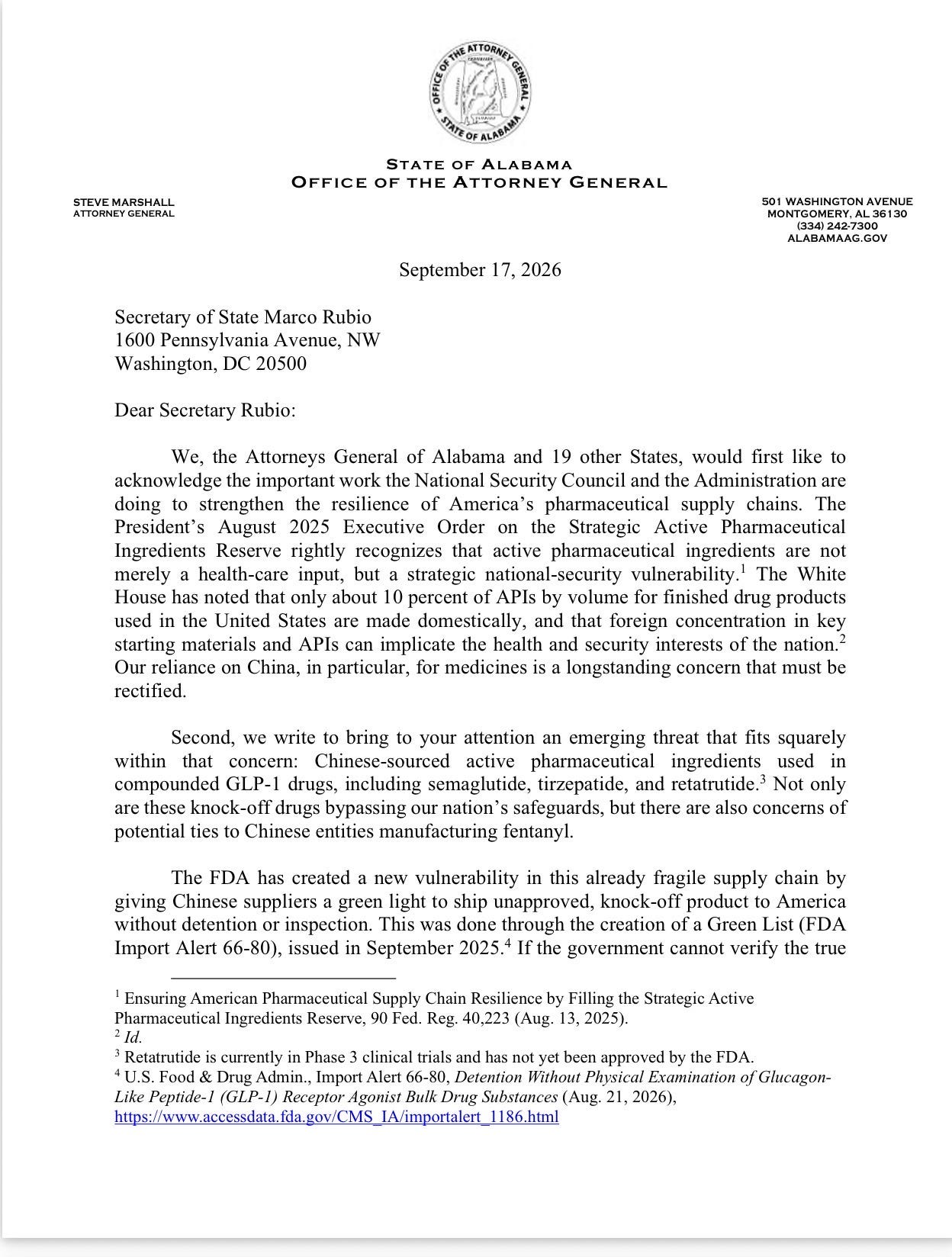
One day before FDA issued the Empower letter, the attorneys general of 20 states asked the federal government to scrutinize Chinese-sourced GLP-1 API and FDA’s Green List. Their argument gained urgency after FDA found that a Green List company allegedly obtained semaglutide API from a non-Green List source, repackaged and relabeled it, then distributed it into the United States.

That is certainly worth understanding more about, but the Green List itself was designed as a step toward greater visibility into foreign API sourcing. If that system can be gamed, strengthen chain-of-custody requirements, increase inspections and punish companies that obscure where API actually came from.
After all, if drugs coming from China are tantamount to a national-security threat, we should be prepared to tackle that issue across the entire American pharmaceutical supply chain, not only when the finished product is compounded. FDA says more than half of pharmaceuticals distributed in the United States are manufactured overseas, while only 11% of API manufacturers are U.S.-based compared with 22% in China and 44% in India. FDA also reports that 53% of branded drugs and 69% of generic drugs are manufactured outside the United States.
That does not make the concerns raised by the attorneys general illegitimate. It does make the uniquely intense focus on compounded medications harder to separate from the broader pressure already surrounding this market, and calls into question the ultimate source and intent behind the highlighted concerns.
It’s worth reminding patients everywhere that, of the 20 states whose attorneys general signed onto this letter, only one has chosen to participate in the Medicaid GLP-1 BALANCE program, which would give participating states access to significant negotiated discounts on branded obesity medications for some of their most vulnerable residents. Boxing citizens out of negotiated branded GLP-1 discounts while simultaneously choking off access to the only lifeline some of these patients have to treatment would be a political catastrophe. GLP-1 access is a rare bipartisan issue in an era where nearly every other issue is filtered through a red-team, blue-team lens. Patients do not care which party gets credit for helping them afford treatment. They care whether they can get the medicine their doctor believes they need, and policymakers on both sides should be very careful about becoming the reason they cannot.
A Regulatory Framework Nobody Could Have Foreseen
There is another reality that gets lost whenever we talk about Sections 503A and 503B as though they were written with this moment in mind. No one could have foreseen when writing policy around 503A and 503B a world where millions of people every month would be clamoring for an injectable peptide that simultaneously served as a major solution for one of the biggest health problems facing America over the last half-century: obesity.
That does not erase the law, excuse bad manufacturing or give compounders permission to ignore regulatory boundaries. It does help explain why a regulatory framework built for a very different compounding world is suddenly being stress-tested in ways its architects could not have possibly forseen.
Now add retatrutide to the backdrop. Lilly and FDA reach oral arguments September 24 over whether the drug should ultimately be classified as a conventional drug or biologic, another seemingly technical distinction with potentially enormous implications for the future compounding landscape.
Patients Are Still in the Middle
The hardest part is figuring out where any of this leaves patients. Compounded GLP-1s have served millions of people who, in the wake of branded shortages ending, have increasingly turned to them because branded obesity medications have been hard to get in primary care settings, unaffordable and simply excluded by insurance. Unfortunately, recent coverage trends suggest that traditional access is hardly moving in the right direction.
We should demand safe sterile manufacturing, truly individualized prescribing where the law requires it and transparent API sourcing. Those are legitimate expectations, but they exist alongside another reality: regulators continue narrowing alternative access pathways while millions of Americans still cannot reliably afford the FDA-approved products they are being told to use instead.
The temperature is rising around compounded GLP-1s, but nobody is “cooked,” and patients are once again standing directly in the middle of a fight over access, regulation and a pharmaceutical system that still has not solved the most basic problem of all.