Eli Lilly’s lawsuit against Mochi Health has never really been just about Mochi. It is one piece of a much larger effort by Lilly to tighten the walls around tirzepatide, using litigation, regulatory pressure, advertising claims and challenges to the business models that have allowed non-branded versions of the drug to reach patients outside the traditional Mounjaro and Zepbound channels.
When we last covered this case, Lilly appeared to have found a more credible path forward after initially struggling to establish the type of injury necessary to keep the lawsuit alive. The company had started building its argument around reputational harm, lost sales, patient diversion and the way compounded tirzepatide was being positioned in the market, creating a legal theory that could potentially be reused elsewhere if it gained traction.
The latest ruling pushes the case further into that territory, but it also opens another front that may be even more consequential for the broader compounded tirzepatide market. On September 8, U.S. District Judge Jacqueline Scott Corley partially granted and partially denied the defendants’ latest motion to dismiss, rejecting Lilly’s effort to hold Mochi Medical and Aequita Pharmacy liable for a false advertising conspiracy while allowing Lilly to keep pursuing Aequita under California’s Unfair Competition Law based on allegations involving the corporate practice of medicine.
What this means practically is that Lilly now has one theory moving forward that reaches beyond what was said in an advertisement and into how compounded tirzepatide was actually being prescribed, managed and dispensed. For an industry built around telehealth companies, professional medical entities and partner pharmacies, that gives this case implications well beyond one defendant.

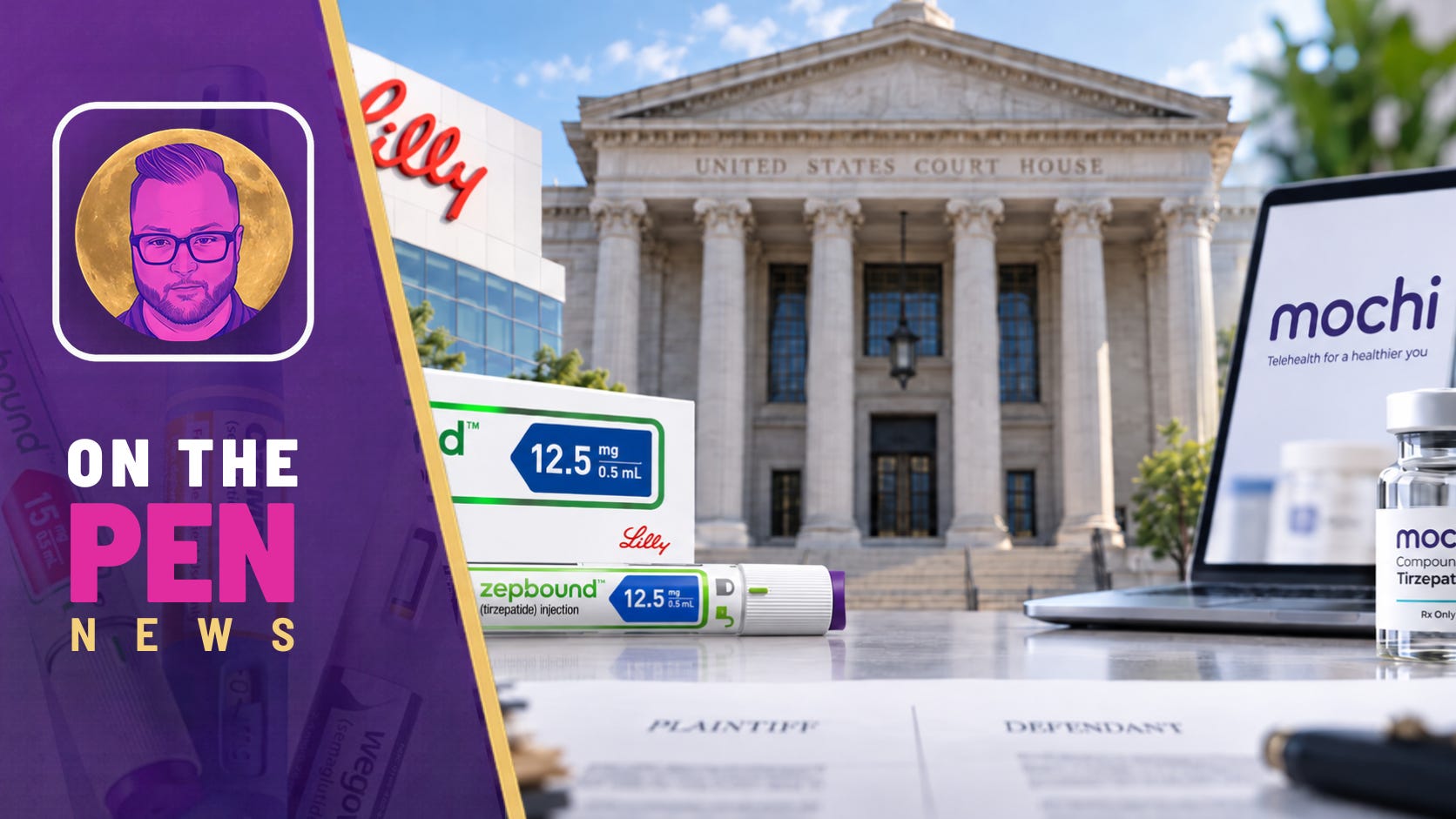
Illustration: On The Pen. Composite image depicting Eli Lilly, Mochi Health and the legal dispute over compounded tirzepatide.
Lilly’s broader fight over non-branded tirzepatide
Lilly has been fighting non-branded tirzepatide on multiple fronts for years now, and the Mochi case has always been a big piece of that larger strategy. The company has challenged compounders, telehealth sellers and the market positioning around compounded GLP-1 medications while continuing to protect the commercial moat around Mounjaro and Zepbound.
What has always made this particular lawsuit interesting is that it is not a straightforward patent case. Lilly is not arguing here that Mochi copied tirzepatide in the traditional intellectual property sense, but instead focusing on what happens around the drug, including how patients are marketed to, how prescriptions are generated and whether the companies involved in delivering that care are operating as independently as they appear on paper.
That framework is what gave this case broader implications from the beginning. If Lilly can establish a workable theory around lost sales, reputational harm, patient diversion or improper control over medical care, it gives the company a legal roadmap that could potentially be used against other telehealth and compounding arrangements offering non-branded tirzepatide.
The latest order shows that Lilly has had mixed success building that roadmap. In an earlier round, Corley found that Lilly had shown relationships among Mochi Health, the Mochi Medical entities and Aequita, but not enough to support a conspiracy claim, so Lilly amended again and came back with more specific allegations.
This time, the court found enough to let one part of the conspiracy theory survive. According to Lilly, Mochi CEO Myra Ahmad and her husband, Abraham Chaibi, controlled the Aequita entities, while Aequita had a financial incentive to continue practices Lilly says blurred the line between business operations, pharmacy operations and clinical decision-making.
Lilly also alleges that Aequita was filling large numbers of identical prescriptions despite compounded medications being presented as individualized or personalized treatments. The judge has not found those allegations to be true, but she did find them specific enough to allow Lilly to continue testing them in court.
For the broader compounded tirzepatide market, this opens a different kind of legal exposure. Lilly does not necessarily need a court to declare compounded tirzepatide itself unlawful if it can instead successfully argue that the system surrounding its prescribing or dispensing violated other laws.
And this is where the case starts moving away from a simple debate over whether compounding should exist at all. Lilly is increasingly testing whether the legal and corporate infrastructure supporting compounded tirzepatide can withstand scrutiny once courts start looking at who controlled the patient relationship, who controlled the pharmacy and who was actually making medical decisions.
Lilly lost part of the advertising fight, but gained a path into discovery
The false advertising side of the ruling went against Lilly. The company wanted to hold Mochi Medical and Aequita responsible for Mochi Health’s alleged false advertising through civil conspiracy, but Corley found that Lilly had not shown enough actual conduct by those entities to connect them to the advertising itself.
Lilly argued that Mochi Medical had a financial stake in the advertising because those ads brought patients into the business, but Corley rejected financial benefit alone as a basis for conspiracy liability. In one of the clearest lines in the order, she wrote that “increasing revenue is not a tort.”
That is a meaningful limit on how far Lilly can stretch this case. Selling compounded tirzepatide is not automatically the unlawful act, and making money from compounded tirzepatide is not automatically the unlawful act either, so Lilly still has to identify the specific wrongdoing and show how each party actually helped carry it out.
The court made the same point when Lilly described Aequita as participating in a “tirzepatide-selling scheme.” Corley wrote that the object of the alleged conspiracy could not simply be selling compounded tirzepatide, because the relevant alleged wrong was false advertising and Lilly had not shown how Aequita actually advanced that conduct.
Even a co-branded announcement between Mochi and Aequita was not enough because the complaint did not explain what Aequita did to create or distribute the advertising beyond having its name appear in the announcement. Lilly’s direct Lanham Act claim against Mochi Health remains alive, but its attempt to extend that liability to Mochi Medical and Aequita through conspiracy was dismissed.
Corley did, however, leave Lilly a narrow path back. The conspiracy theory was dismissed without another automatic chance to amend, but the court said Lilly could seek permission to revive it if discovery turns up facts showing that Mochi Medical or Aequita actually participated in the alleged false advertising.
That becomes especially interesting because Aequita remains in the case on the corporate-practice-of-medicine theory. Lilly may now get access to internal communications, operating procedures and other records that could show how decisions were made across Mochi Health, its medical entities and the pharmacy.
If discovery shows that the business side was directing medical or pharmacy decisions, Lilly’s surviving theory gets stronger. If internal records show Aequita or Mochi Medical participating in advertising decisions, Lilly may also try to revive the conspiracy claim it just lost.
For the compounded tirzepatide industry, this could finally give us a clearer picture of how much separation courts expect between a telehealth company, the medical practice caring for patients, and the pharmacy dispensing the medication. That guidance could influence how companies across the market structure themselves even if they are never named in this case, especially because so much of modern telehealth now runs on shared infrastructure platforms that quietly power prescribing, compliance and pharmacy workflows for millions of patients.
A ruling that redraws those boundaries would not stay confined to Mochi. It could ripple through the broader obesity care market, changing how telehealth companies operate, how pharmacies partner with them, and ultimately how easily and affordably patients in the U.S. can access treatment.
Patient takeaways
For patients, the down-and-dirty question is whether legal pressure like this makes compounded tirzepatide harder to find, more expensive to offer or too risky for some telehealth companies and pharmacies to keep touching. If Lilly succeeds in proving that a telehealth company, medical group and pharmacy were too intertwined, the immediate industry response could be more distance between those entities, more compliance layers and more cautious pharmacy relationships.
Some of that could protect clinical independence, but it also adds cost and friction to a model that became popular because it was fast, simple and often far cheaper than branded GLP-1 care. For millions of patients, it simply works in a healthcare system that increasingly feels like it does not, at least not for them.
That is where price and accessibility come into the picture. The more legal risk and infrastructure these companies have to carry, the more expensive it becomes to operate, and much of those costs will certainly land on patients. Other companies may decide compounded tirzepatide is no longer worth the exposure at all, which could mean fewer pharmacies, fewer telehealth options and less price competition against branded Zepbound.
There is also a tension in Lilly’s argument that gets more interesting the further this case goes. Lilly now operates LillyDirect, a direct-to-patient platform that lets patients browse Lilly’s hand-selected, albeit independent, telehealth providers and, if a medication is prescribed, route that prescription through LillyDirect’s pharmacy pathway. Lilly is explicit that those providers use their own clinical judgment, may prescribe non-Lilly products and are not paid or incentivized by Lilly to prescribe Lilly drugs. But being one of the relatively few telehealth companies featured inside LillyDirect is itself extremely commercially valuable, which at least creates an arguable incentive to remain in Lilly’s good graces. That does not prove prescribing bias, but it does complicate any broader argument that commercial proximity to a prescribing platform is inherently suspect.
That independence, however, is an important factual difference from what Lilly is alleging about Mochi. Lilly says it does not control treatment decisions, does not pay the telehealth providers for referrals and does not incentivize them to promote Lilly products.
But a telehealth defendant could still turn the broader argument back on Lilly and ask where, exactly, the line sits. Lilly itself has built a consumer pathway where a patient can arrive through a manufacturer-controlled platform, be connected with a selected telehealth provider and then have a prescription sent into LillyDirect’s pharmacy network. Lilly’s answer is that the clinical wall is real and the prescriber remains independent, but its case against Mochi is increasingly about whether those walls were real in practice.
That could become one of the more interesting pressure points in the case. If Lilly argues too broadly that commercial architecture around telehealth can itself taint prescribing, defendants will have an obvious incentive to compare that theory with LillyDirect and force Lilly to explain why one model preserves clinical independence while another allegedly crosses the line.
For patients, this is where the bigger picture comes into focus. Lilly is not just fighting one telehealth company, it is testing legal theories that could reshape how non-branded tirzepatide is marketed, prescribed and dispensed across the industry.
If Lilly wins broadly, compounded tirzepatide could become more expensive, less available and concentrated among fewer companies willing to operate under a stricter legal structure. If Lilly loses, telehealth and compounding companies may get a clearer roadmap for how to preserve access while keeping prescribing and pharmacy decisions sufficiently independent.
Either way, the outcome reaches far beyond Mochi. This is one of several fronts in Lilly’s larger effort to protect the branded tirzepatide market, and this particular case could help determine how much room remains for non-branded tirzepatide to compete on price, convenience and access.