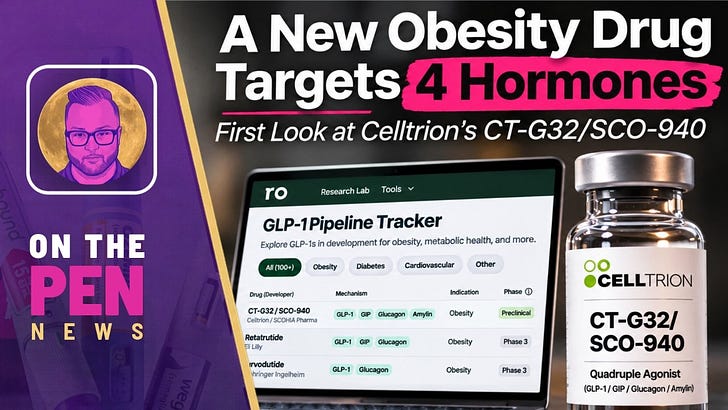
The race to develop the next generation of obesity medications just got a little more interesting. South Korean pharmaceutical company Celltrion and Japan’s SCOHIA Pharma have unveiled preclinical results for CT-G32/SCO-940, an experimental obesity drug designed to activate four hormonal pathways simultaneously in a single molecule.
The candidate targets GLP-1, GIP, glucagon and amylin, adding amylin signaling to the three pathways targeted by Eli Lilly’s investigational drug retatrutide. The approach combines hormonal mechanisms involved in appetite, satiety, glucose regulation and energy metabolism, potentially delivering greater weight loss while addressing one of the biggest concerns surrounding obesity treatment: the loss of lean body mass.
JOIN THE LIVE CONVERSATION:
Early Results Suggest an Advantage Over Retatrutide
In findings presented November 4 at TIDES Europe in Amsterdam, CT-G32/SCO-940 produced numerically greater weight loss than retatrutide at the same molar dose in rats with diet-induced obesity. Researchers also observed a smaller proportion of lean body mass lost during treatment, alongside improvements in elevated insulin levels associated with obesity.
Those results are encouraging, but they come with an enormous qualification that much of yesterday’s hype seemed to miss. These were animal studies, not human clinical trials, and the findings do not establish that the drug will outperform retatrutide in people or preserve muscle during human weight loss. No human efficacy or safety data are available yet, and the companies have not established a clinically meaningful advantage over existing treatments.
Separate testing in nonhuman primates demonstrated sustained drug exposure, supporting the possibility of a once-weekly injection. That would put the drug on a familiar dosing schedule for patients already using injectable obesity medications, assuming subsequent clinical testing supports it.
Patient Takeaways
The timeline: Celltrion plans to submit an investigational new drug application to the FDA in February 2027, with the first participants potentially receiving treatment during the second quarter of 2027. That’s the beginning of human testing, not an anticipated approval date. Even if development proceeds successfully, commercial availability would likely remain years away.
The affordability question: We’re a ways off from this being a relevant question. Since the NDA has yet to be filed, we’re talking beyond 2030 before this has the potential to hit pharmacy shelves. Neither company has announced pricing, insurance coverage arrangements or a patient access strategy. Celltrion has considerable experience manufacturing and commercializing biosimilars, but that does not guarantee this new molecule will be affordable. Patients have already seen what happens when pharmaceutical innovation moves faster than insurance coverage and affordability. The positive news is that the drug will arrive at a time when generics are a relevant part of the access conversation
The bigger picture: More hormonal targets do not automatically mean a better treatment for every patient. What we ultimately need are therapies that deliver meaningful, sustainable weight loss, preserve health and function, and are tolerable enough for patients to remain on long term. CT-G32/SCO-940 is another promising addition to a rapidly expanding pipeline, but its clinical value will depend on what happens when researchers move beyond rats and begin treating people.
Innovation without access is meaningless, and the next generation of obesity medicine will ultimately be judged by how many patients can benefit from it, not simply how many receptors a molecule can activate.