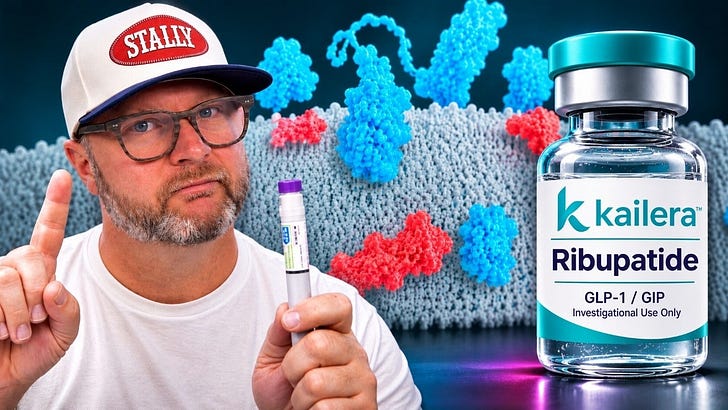
Another potential competitor to Zepbound is making headlines at ObesityWeek 2026, and this one is showing nearly 20% weight loss with remarkably few patients discontinuing treatment because of side effects. The medication is called ribupatide (BOOP!), a once-weekly GLP-1/GIP dual agonist developed by China’s Hengrui Pharmaceuticals and licensed to Kailera Therapeutics outside Greater China.
JOIN THE DISCUSSION LIVE AT 12 EASTERN:
Like tirzepatide, the active ingredient in Mounjaro and Zepbound, ribupatide targets both GLP-1 and GIP receptors. While top-line results from the Phase 3 GEMINI-1 trial were previously announced, the full results were published in JAMA on November 15, coinciding with this year’s ObesityWeek conference.
Nearly 20% Weight Loss at 48 Weeks
The trial enrolled 567 adults in China living with overweight or obesity, without diabetes. Participants received weekly ribupatide injections at target doses of 2 mg, 4 mg, or 6 mg, or placebo, for 48 weeks. Average weight loss ranged from 10.7% at the lowest dose to 17.7% at the highest, compared with just 1.4% for placebo.
Treatment Average weight loss
Ribupatide 2 mg 10.7%
Ribupatide 4 mg 16.4%
Ribupatide 6 mg 17.7%
Placebo1.4%
A separate analysis estimating outcomes without early treatment discontinuation or certain other treatment changes found weight loss as high as 19.2% at the 6 mg dose. For perspective, 17.7% represents approximately 44 pounds for someone starting at 250 pounds, and more than 44% of participants receiving the highest dose lost at least 20% of their starting body weight. Interestingly, researchers reported that weight loss had not clearly plateaued at the higher doses by week 48, suggesting additional weight reduction may be possible with longer treatment.
The Side Effects Tell an Interesting Story
Ribupatide has an approximately seven-day half-life, compared with roughly five days for tirzepatide, meaning it remains in the body somewhat longer. If you ever feel like tirzepatide effects drop off considerably at the end of the week, this may explain why. Whether the longer half life translates into any meaningful clinical advantage remains unknown, but the medication’s gastrointestinal side effect profile revealed something else worth examining.
At the highest dose, 27% of participants reported nausea, 24% reported vomiting, and 36% reported diarrhea. Even more unusual, at the 4 mg dose, vomiting was reported more frequently than nausea, 19% versus 17%. That’s not the typical pattern observed in GLP-1 trials, where nausea generally occurs considerably more frequently than vomiting. For comparison, nausea rates in the SURMOUNT-CN tirzepatide trial ranged from 30% to 32% at the two highest doses, while vomiting occurred in 11% to 20%.
Despite these gastrointestinal side effects, treatment discontinuation due to adverse events was surprisingly low, ranging from just 0.7% to 1.4% across the three ribupatide doses. Approximately 90% of patients completed the 48-week treatment period, suggesting that while side effects were relatively common, they rarely resulted in patients permanently stopping treatment during the trial. Whether similar tolerability will be observed in broader patient populations remains to be seen.
Could Ribupatide Challenge Zepbound?
In the SURMOUNT-CN trial, tirzepatide produced average weight reductions of 13.6% and 17.5% at its two highest doses over 52 weeks. Ribupatide’s 17.7% reduction at 48 weeks certainly puts it in competitive territory, although comparisons between separate clinical trials cannot establish which medication is more effective or better tolerated.
Beyond weight loss, researchers also observed improvements in blood pressure, triglycerides, waist circumference, and insulin resistance. Kailera is advancing ribupatide through a global Phase 3 development program, which should provide a clearer picture of how this medication performs across broader patient populations and potentially against existing treatments.
Patient Takeaways
The emerging story from ObesityWeek 2026 isn’t simply that another medication can produce weight loss approaching 20%. It’s that the obesity treatment pipeline continues to expand, potentially giving patients more options when existing medications don’t deliver adequate results or tolerable side effects. Ribupatide’s efficacy is impressive, and its low discontinuation rates are certainly encouraging, but longer-term safety data and additional studies will be necessary before we fully understand where it fits in obesity treatment.
As competition intensifies, the conversation needs to extend beyond which medication produces the greatest weight loss. The best obesity medication is the one a patient can tolerate, afford, access, and remain on long term. And while ribupatide represents another promising scientific advancement, we cannot lose sight of the reality that innovation without access is meaningless.
Source: GEMINI-1 Randomized Clinical Trial, JAMA, November 15, 2026
On The Pen provides independent obesity medicine reporting and patient advocacy. This article is for informational purposes and is not medical advice. I am not a medical professional.