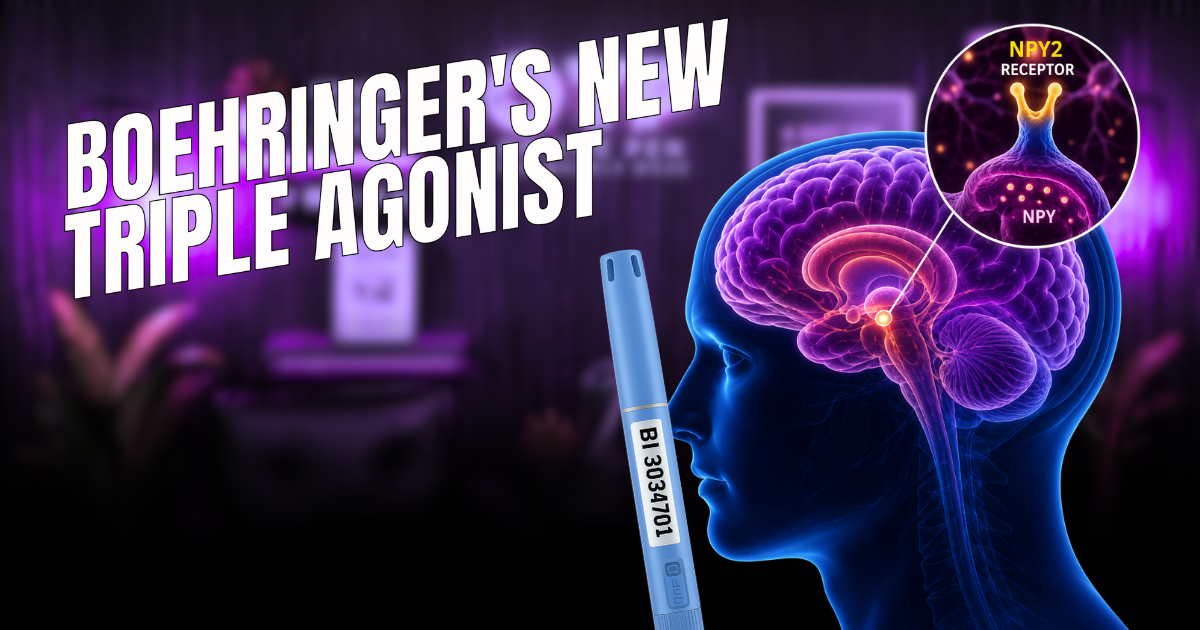
Over the past few years, we’ve watched obesity medicines evolve from our favorite GLP-1 therapies we discuss like semaglutide, or dual agonists like tirzepatide, and now to triple agonists like retatrutide. Each generation has targeted more biological pathways than the last, and each has delivered greater weight loss by treating obesity as the complex biological disease that it is. Now Boehringer Ingelheim is betting the next leap forward won’t come from simply adding another incretin hormone. Instead, it’s adding an entirely different hunger pathway. The company has announced that its investigational obesity treatment, BI 3034701, has advanced into Phase 2 clinical trials. It’s a first-in-class molecule designed to activate GLP-1, GIP, and the neuropeptide Y2 (NPY2) receptor all at the same time.

If you’re taking tirzepatide, you already understand why this is exciting. GLP-1 and GIP proved that targeting multiple pathways works. Retatrutide took that idea one step further by adding glucagon. Boehringer is now exploring a different direction. Rather than adding another incretin hormone, it’s leveraging the proven success of GLP-1/GIP combinations while introducing an entirely new pathway aimed at dialing down one of the brain’s strongest biological hunger signals.

That pathway is called NPY2, and while most patients have never heard of it, they’ve almost certainly experienced what it’s is trying to control. Your brain has specialized neurons that produce a molecule called neuropeptide Y, or NPY. Think of NPY as one of your body’s loudest hunger signals. When your brain senses that energy is running low, whether because you’ve skipped meals, lost weight, or are in a calorie deficit, NPY activity increases and starts pushing you to eat. It’s one of the reasons hunger often gets stronger during weight loss and one of the reasons obesity fights so hard to defend the weight your body has been carrying.

Fortunately, your body also has a natural braking system. After you eat, your intestines release a hormone called PYY. One form of that hormone activates the NPY2 receptor, which acts like a brake on those hunger-producing neurons. If GLP-1 tells your brain, “You’re full,” NPY2 may tell your brain, “You don’t need to keep looking for food.” That might sound like the same thing, but they’re actually very different biological processes. One increases satiety. The other may reduce the biological drive to eat in the first place. That’s exactly why researchers are so interested in this pathway.

This is also what makes BI 3034701 such an interesting scientific strategy. Boehringer isn’t abandoning what we’ve already learned about obesity medicine. It’s building on it. The company is taking the proven success of GLP-1 and GIP, then adding a pathway that may help address one of the biggest challenges in obesity treatment, the body’s tendency to fight back as weight comes off. Anyone who’s lost a significant amount of weight knows exactly what that feels like. At some point, the hunger gets louder. Food occupies more of your thoughts. It becomes harder to maintain the same calorie deficit that felt manageable just weeks earlier. Researchers believe the NPY pathway is one of the biological systems involved in that response. If they’re right, activating the NPY2 receptor could help reduce some of that biological pushback.

The fact that BI 3034701 has advanced into Phase 2 is a huge milestone. Drug development is incredibly difficult, and many investigational medicines never make it this far. Advancing into Phase 2 means Boehringer generated enough early safety and pharmacology data in Phase 1 to justify asking the next set of questions. Does adding NPY2 produce more weight loss than GLP-1/GIP alone? Does it help patients maintain weight loss by reducing biological hunger? Can it deliver those benefits without causing too much nausea or other gastrointestinal side effects? Those are exactly the questions Phase 2 is designed to answer.

One recurring theme on our podcast and live shows is that there is tremendous hope in the obesity pipeline, especially for patients who haven't responded to today's therapies or simply couldn't tolerate them. BI 3034701 represents exactly the kind of innovation we've been waiting for. Rather than trying to improve on GLP-1 by adding another incretin hormone, it's introducing an entirely new biological pathway into the equation. Whether this molecule ultimately succeeds remains to be seen, but if NPY2 proves to be an effective target, it could open the door to an entirely new class of obesity medicines and offer new hope for patients still waiting for the treatment that finally works for them.

Whether BI 3034701 ultimately succeeds or not, this announcement tells us something important about where obesity medicine is headed. Drug developers have moved well beyond the idea that there’s one magic hormone or pathway responsible for obesity. They’re recognizing what patients have lived for years. Obesity is driven by multiple biological systems, and it may ultimately require treatments that target multiple biological systems. GLP-1 changed the game. Tirzepatide proved that two pathways were better than one. Retatrutide expanded that idea even further. We’ve even covered a quintuple agonist in early stages. Now Boehringer is asking whether the next breakthrough could come from finally turning down one of the brain’s strongest hunger signals. If that hypothesis proves correct, BI 3034701 could represent another important step toward treating obesity as the complex, multifaceted disease we know it is. Exciting times…

-DK