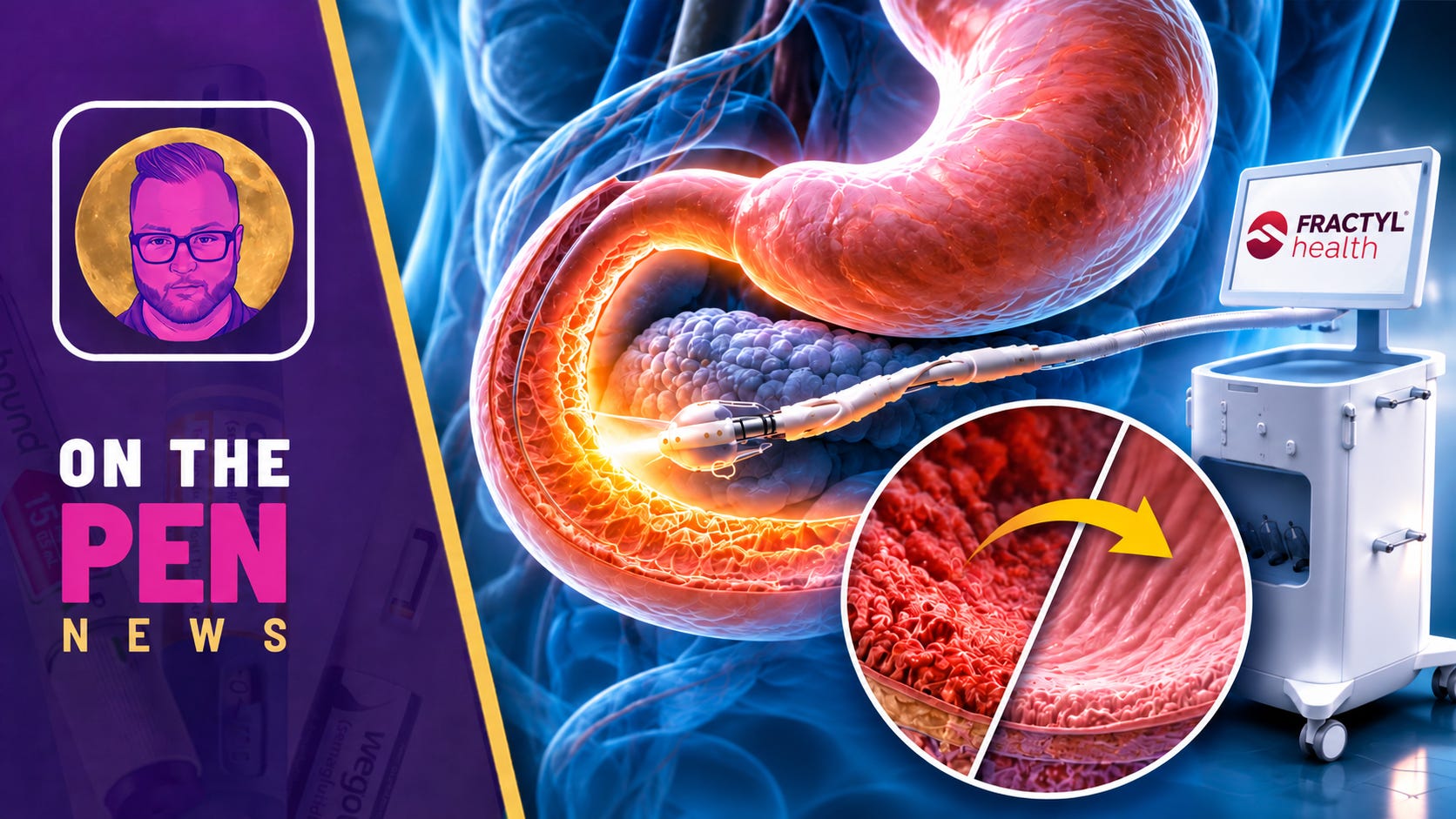
For nearly two years, Fractyl Health CEO Harith Rajagopalan has been making the same argument in conversations with On The Pen: the next major problem in obesity treatment is not just helping patients lose weight, but figuring out what happens when they want to, have to, or need to stop the medication that got them there.

Fractyl now has pivotal data behind that thesis. The company said Friday that its 308-participant REMAIN-1 pivotal cohort met its prespecified six-month co-primary endpoint, with patients who received a single Revita procedure regaining significantly less weight after stopping tirzepatide than those who underwent a sham procedure.
In the modified intention-to-treat population, Revita patients retained roughly 80% of their GLP-1-induced weight loss at six months compared with 67% for sham. Adjusted weight regain was 5.1% of body weight in the Revita group versus 8.2% in sham, a highly statistically significant difference with a p-value of 0.0023.
That is the most important Revita result Fractyl has reported to date because this is no longer an open-label signal or a small exploratory cohort. REMAIN-1 is a multicenter, randomized, double-blind, sham-controlled pivotal study designed specifically to test whether a one-time duodenal procedure can meaningfully change the trajectory of weight regain after GLP-1 discontinuation.
The off-ramp thesis moves into pivotal territory
When On The Pen first began covering Revita, the concept was compelling but still highly experimental. Patients would lose substantial weight on a GLP-1, stop treatment, then undergo a one-time endoscopic procedure designed to remodel the duodenal lining and potentially alter nutrient sensing and metabolic signaling.
Rajagopalan has repeatedly described Fractyl’s broader goal as moving metabolic disease away from chronic management and toward disease modification. In patient terms, the pitch has always been much simpler: use a GLP-1 to lose the weight, then potentially use Revita as an off-ramp from indefinite drug therapy.
Earlier studies offered encouraging signals. In REVEAL-1, patients retained approximately 78% of their GLP-1-induced weight loss at one year, while the smaller randomized REMAIN-1 Midpoint Cohort suggested the effect could be even stronger when the procedure achieved more complete duodenal ablation.
The pivotal data now give Fractyl something those earlier studies could not: a statistically significant result across hundreds of randomized participants. The difference between Revita and sham also widened over time, with the treatment effect nearly doubling between months three and six.
Another potentially important signal came from a post hoc analysis showing that 32% of Revita-treated participants were either weight stable or had lost additional weight at six months after stopping GLP-1 therapy, compared with 18% in the sham group. Because that analysis was post hoc, it should be interpreted more cautiously, but the nominal p-value was 0.020.
More complete ablation appears to matter
Fractyl has increasingly emphasized that procedural completeness may be a major driver of Revita’s effect, and the new pivotal data add to that case. In a post hoc analysis, patients who received 12 to 18 centimeters of duodenal ablation regained 4.7% of body weight compared with 8.2% in sham, representing roughly 43% less regain.
Among patients receiving at least 20 centimeters of ablation, average regain fell to 3.8%, representing a 53% reduction compared with sham. That finding was nominally significant at p=0.003 and is consistent with the earlier Midpoint Cohort, where more complete treatment also appeared to produce a larger effect.
The apparent dose-response relationship is encouraging because it strengthens the argument that the procedure itself is driving the outcome. It also creates an important commercial question for Fractyl: whether physicians can reproduce that degree of procedural completeness consistently once Revita moves outside a tightly controlled clinical trial.
That could make training, technique and procedural standardization critical parts of any eventual rollout. If the magnitude of benefit depends in part on how much of the duodenum is successfully treated, execution may matter almost as much as patient selection.
Fractyl is already building toward launch
The company now plans to submit a De Novo marketing application to the FDA in late Q4 2026, with topline one-year results from the pivotal cohort expected in the first quarter of 2027. Those data will include the study’s second co-primary endpoint, which measures the proportion of Revita-treated participants maintaining at least 5% total body weight loss relative to their pre-tirzepatide weight.
Fractyl has also secured Category III CPT code 1122T for the Revita procedure, which takes effect January 1, 2027. The company is guiding toward a potential FDA authorization in late 2027 and a possible U.S. launch in early 2028.
Safety remains an important part of that regulatory story. As of the September 24 data cutoff, Fractyl reported no device- or procedure-related serious adverse events, no deaths and no unanticipated adverse device effects. Most related adverse events were mild and clustered around the procedure, with 94% occurring within seven days.
That profile is central to how Fractyl is positioning Revita. The company is not trying to compete with bariatric surgery, but rather establish a new outpatient procedural category that could sit between chronic pharmacotherapy and more invasive surgical intervention.
Patient Takeaways
For patients, today’s result is significant because a large randomized pivotal trial has now shown that Revita can reduce weight regain after tirzepatide discontinuation compared with a sham procedure. Patients still regained some weight, so this is not evidence that Revita permanently “locks in” every pound lost, but it does suggest the early post-GLP-1 trajectory can be meaningfully altered.
The bigger durability question is still ahead. Six months tells us Revita can change what happens early after treatment stops, while the 12-month data expected in early 2027 will tell us much more about whether that benefit holds.
This distinction is important as the question patients keep asking is not simply whether they can lose weight on a GLP-1. It is what happens when access to the med is taken away, or is simply no longer an option.
Fractyl has spent years arguing that the answer could lie in the science behind Revita. Today’s REMAIN-1 result moves that argument much closer to becoming a clinically credible one.