JOIN THE DISCUSSION LIVE AT NOON EASTERN! 👇
Hackers hit refrigeration systems across Europe on Monday, remotely raising temperatures inside supermarket refrigerators and freezers and forcing stores to throw away food. At one Swedish supermarket, a manager told Reuters that freezers reached 50 degrees Celsius, or 122 degrees Fahrenheit. Similar attacks in France last month affected hundreds of supermarkets, spoiled food and, in some cases, caused refrigeration units to catch fire.
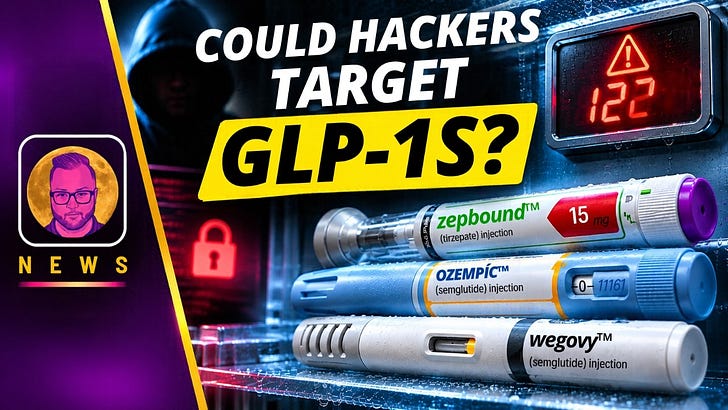
As a community of readers who collectively fear the idea of losing access to our GLP-1 medication, you already know where I am going with this, don’t you? While there is currently zero evidence that pharmaceutical refrigerators or GLP-1 medications are currently being targeted specifically, these attacks expose a vulnerability that becomes rather terrifying when you extrapolate the potential target out to industrial refridgerators containing millions of dollars worth of GLP-1 therapies.
The cold chain is now part of the cyberattack surface
Injectable GLP-1 drugs move through a tightly controlled supply chain before they ever reach a patient’s refrigerator. Manufacturers, distributors and pharmacies rely on refrigeration, temperature monitoring, inventory systems and logistics infrastructure to keep those products within their approved storage conditions.
Zepbound, for example, is generally stored between 36°F and 46°F, although FDA labeling allows it to remain at temperatures up to 86°F for as long as 21 days. It should not be frozen. Other injectable GLP-1 products have their own storage requirements.
Refrigeration failure would not automatically destroy every GLP-1 pen inside. The larger issue would likely be proving what happened to them.
If hackers manipulated a pharmacy or distribution center’s refrigeration system, companies would need to know how hot the medication became, how long it stayed there and whether the temperature records themselves could still be trusted. If those questions cannot be answered verifiably, inventory could potentially need to be quarantined while its integrity is evaluated. If done on a large enough scale, this could certainly disrupt supply.
We’ve already seen what cyberattacks can do to healthcare
This isn’t entirely theoretical. The Change Healthcare attack which we covered back in 2024 disrupted prescription processing across the US, with CMS acknowledging that the incident affected some patients’ ability to obtain prescriptions. More recently, Boston Scientific said a 2026 cyberattack disrupted manufacturing and order processing badly enough that the medical device maker no longer expected to meet its previous full-year sales and profit forecasts.
The refrigeration attacks introduce another possibility. Instead of locking a company out of its computers, an attacker could manipulate the physical infrastructure those computers control.
The Pentagon is already investigating freezer malfunctions at several US military commissaries as a suspected cyberattack. At one location, a freezer reportedly switched into defrost mode overnight and spoiled its contents. Investigators have been communicating with French authorities examining similar attacks overseas.
AI could make the problem bigger
European cybersecurity officials told Reuters they are increasingly concerned that AI can help sophisticated attackers exploit vulnerabilities in IT systems. That is where the threat becomes particularly difficult to predict. AI doesn’t have to invent a new form of cyberwarfare. Lowering the expertise, time or manpower required to find vulnerable connected systems could allow existing attacks to happen at greater scale.
And pharmaceutical distribution has plenty of digital dependencies. Manufacturing systems, warehouse software, electronic prescribing, insurance claims, pharmacy ordering, logistics and temperature monitoring all create potential points of disruption.
For GLP-1s, even a relatively contained event could have outsized consequences because demand remains enormous and patients have already lived through years of intermittent shortages.
A cyberattack that temporarily quarantined inventory at a major distributor could create shortages without actually destroying a single pen. News of that disruption could then prompt patients to refill early, move prescriptions between pharmacies or search for alternative supply, adding another layer of demand to an already stressed system.
Patient takeaways
This isn’t a call to start stocking your doomsday bunker full of GLP-1 pens. I would recommend having a little margin for error where possible. Know the storage requirements for your specific medication, avoid waiting until the last possible day to request a refill. Different insurance companies have different refill policies, some allowing you to refill a 90 day supply every 60 days.
If a pharmacy ever tells you that your medication experienced a refrigeration or temperature problem, don’t decide on your own whether it is still usable. Ask the pharmacist or manufacturer to determine whether the specific temperature excursion falls within the product’s approved storage limits. This is especially important with compounded medications which lack uniform guidance and regulations.
And if a disruption ever does create a shortage, be especially cautious about unfamiliar sellers suddenly promising readily available GLP-1s online. Scarcity creates opportunity not only for hackers, but for counterfeiters and bad actors willing to exploit patients desperately trying to stay on treatment.
For years, the central question surrounding GLP-1 supply has been whether drugmakers can manufacture enough medicine to meet extraordinary demand. As more of the infrastructure surrounding those medicines becomes connected to the internet, there may be another question worth asking.
What happens when the medicine exists, but the systems we depend on to safely deliver it don’t?