Retatrutide is not even on the market yet, and Eli Lilly is already developing another triple agonist that could take the same basic idea in a very different direction. A newly registered Phase 2 obesity trial will test LY4086940, an experimental drug targeting GLP-1, GIP and glucagon, the same three hormone receptors targeted by retatrutide.
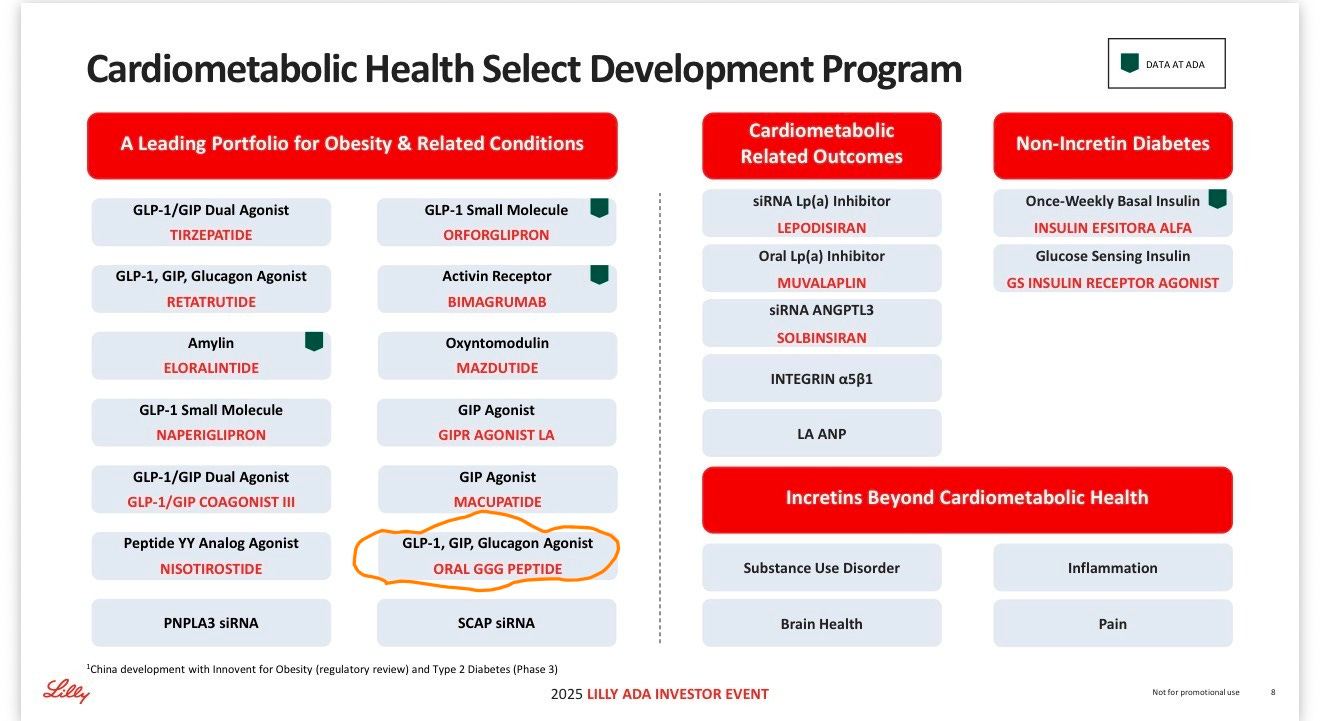
The big difference is how patients would take it. LY4086940 is oral, and Lilly has previously described this program as an “oral GGG peptide.” That last word is what makes this especially interesting.

An oral peptide, not another orforglipron
Most of the incretin drugs patients know, including semaglutide, tirzepatide and retatrutide, are peptides. Peptides are generally difficult to deliver by mouth because the digestive system can break them down before enough intact drug reaches circulation, which is one reason these medicines have traditionally been injected.
Lilly already has an oral GLP-1 in orforglipron, but that drug solves the problem differently. Orforglipron is a small molecule, not a peptide. LY4086940 appears to represent another approach entirely: keeping the peptide structure while trying to deliver a drug targeting three metabolic receptors orally.
Oral peptide delivery itself is not unprecedented. Oral semaglutide already exists, using an absorption enhancer to help the peptide survive and cross through the stomach. What is unusual here is Lilly applying an oral peptide strategy to a triple agonist rather than a drug targeting GLP-1 alone.
Now comes the weight-loss test
Lilly has already completed a Phase 1 study of LY4086940 involving 219 participants. The newly registered Phase 2 study plans to enroll roughly 460 adults with obesity or overweight without type 2 diabetes, testing multiple doses and titration schedules against placebo.
The primary endpoint is weight loss at 32 weeks, with additional data collected through 48 weeks. The study is expected to begin in November 2026, which means we do not have the weight-loss numbers yet.
Why I’m watching it
The bigger signal is what Lilly is attempting. Tirzepatide targets two metabolic pathways, retatrutide targets three through an injection, and now Lilly is testing whether a three-receptor peptide can be delivered orally.
If it works, this could become another branch of obesity medicine entirely: drugs approaching the complexity of the newer injectables without necessarily requiring patients to inject themselves every week.
Patient takeaways
For patients, the hope here goes beyond convenience. There are plenty of people who want the benefits of these medicines but do not want an injection, whether because of needle anxiety, travel, storage, or simply wanting something that fits more easily into everyday life. An effective oral triple agonist could eventually give those patients another option without necessarily sacrificing the multi-hormone approach that has made drugs like retatrutide so interesting.
Cost is more complicated than simply assuming a pill will be cheaper to make. Our best comparison is the Wegovy pill, another oral peptide, and the 25 mg daily dose uses far more semaglutide API each week than the 2.4 mg once-weekly injection because oral peptide absorption is so inefficient. Even so, the Wegovy pill launched at a lower self-pay price than its injectable counterpart despite delivering broadly similar efficacy.
The future of obesity medicine will be judged not only by which drug produces the biggest weight-loss number, but by how easy it is to take, how broadly it can be distributed, and what patients are ultimately asked to pay for it.
And there is one more question worth keeping in the back of our minds: if retatrutide ultimately ends up regulated as a biologic, could an oral triple-agonist peptide potentially fall on the traditional drug side instead, and if it did, could that eventually translate into a cheaper path for patients?
We don’t know that yet, but it is exactly the kind of downstream question this program raises.