There is a particular kind of cruelty in being told that medical science finally recognizes your condition as a disease, not a personal failure. Then, even with effective treatments now available, you are told to fall back on the same old approaches built for an era when science misunderstood the problem.
For millions of people living with obesity, the last few years have brought something medicine had denied our community for generations: proof that our bodies are not simply the product of weaker character, failed discipline, or some defect in moral character.
For at least some people covered under a Mass General Brigham-sponsored plan, that day arrives January 1, 2027. You might reasonably ask, “Why should a decision made by an East Coast health system matter to me?” Because there may be no health system in America where a decision like this feels more at odds with its own scientific legacy.
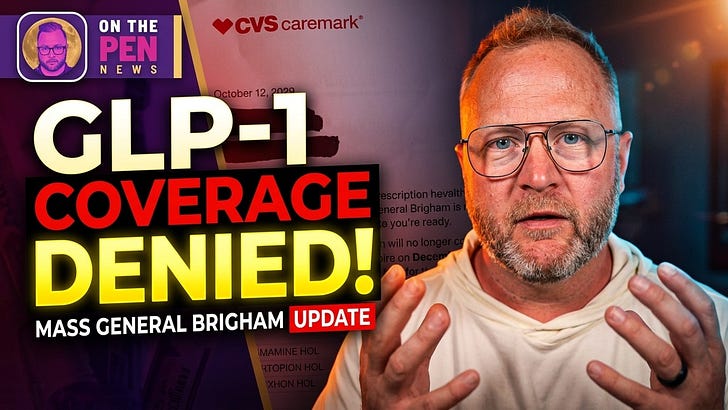
A CVS Caremark letter obtained by On The Pen dated 10/12/2026 says the Mass General Brigham plan covering the addressed member will no longer pay for medications prescribed for weight management. Existing prior authorizations expire December 31, 2026. The exclusion reaches well beyond Wegovy and Zepbound, sweeping in Saxenda, Contrave, Qsymia, phentermine, orlistat and other medications used to treat obesity.

The road to GLP-1 runs through Mass General
Believe it or not, the scientific road that ultimately made modern obesity medications possible runs straight through Massachusetts General Hospital, now part of the Mass General Brigham system.
In the early 1980s, researcher Joel Habener helped uncover the biology that would lead to GLP-1. Svetlana Mojsov, working at Massachusetts General Hospital, helped identify and synthesize the biologically active form of GLP-1 and establish its insulin-stimulating effects. Decades later, their work would help underpin arguably one of the most consequential drug classes in human history.
Habener and Mojsov, alongside Novo Nordisk scientist Lotte Bjerre Knudsen, received the 2024 Lasker-DeBakey Clinical Medical Research Award for discoveries that led to GLP-1 medicines for obesity. Mass General Brigham itself proudly says the research leading to GLP-1 medications “originated right here.”
That history makes the irony of this story almost unbearable: the same health system that now proudly claims this scientific legacy is allowing its benefits structure to treat obesity like a behavior problem all over again. The health system now making this benefits change traces part of its own scientific legacy to researchers who helped uncover the signals governing insulin secretion and human metabolism. Physicians spent years explaining that obesity is not simply a failure to “put the fork down.” Researchers helped expose how incomplete, and sometimes cruel, our old assumptions about body weight had been.
And somewhere deeper in the administrative machinery of a health system that generated $22.8 billion in operating revenue in 2025, another decision was made: beginning January 1, GLP-1 medications prescribed for weight loss will no longer be covered through the pharmacy benefit of affected Mass General Brigham employee medical plans. In a statement to On The Pen, Mass General Brigham confirmed it will instead continue offering financial assistance to eligible employees and covered family members through a Health Reimbursement Arrangement, with greater assistance available to employees at lower wage levels.
To its credit, Mass General Brigham is not simply eliminating the benefit and leaving employees with nothing. The system says eligible employees and family members will have access to a Health Reimbursement Arrangement, with greater financial assistance going to workers at lower wage levels, along with personalized benefits support through its Health Pros team. In an environment where the price of these medications has forced employers into increasingly difficult decisions, that is a more thoughtful approach than simply closing the door.
But it also reinforces the question at the heart of this story. Why does treatment for obesity require a separate, wage-tested financial assistance structure after being removed from the normal pharmacy benefit? The issue is not that Mass General Brigham offered nothing. It is that treatment for a disease its own institutions helped us understand is once again being placed into a different category, one requiring a special pathway to access care that had previously been treated like an ordinary prescription benefit.
The question is not whether a reimbursement program is better than nothing. Of course it is. The question is why obesity treatment keeps being asked to settle for “better than nothing” when we increasingly claim to treat obesity like every other chronic disease.
Obesity is a disease, until the bill arrives
Mass General Brigham doesn’t need us to convince it that obesity is a chronic disease. Massachusetts General Hospital’s own Weight Center says it plainly, explaining that genetics, medications, environment, stress, sleep and other biological factors contribute to obesity, and that simply eating less and moving more does not always successfully treat it.
The World Health Organization describes obesity as a chronic disease driven by complex biological, environmental and social forces. Modern obesity medicine increasingly recognizes that long-term treatment may be necessary, just as it is for hypertension, high cholesterol or diabetes.
So the issue here isn’t ignorance. Mass General Brigham knows exactly what obesity is. That is why this feels like such a profound institutional shortcoming. It is one thing for society to misunderstand a disease. It’s another for an institution that helped illuminate its biology to understand it, and articulate it, perfectly well, then move access to treatment outside the traditional pharmacy benefit.
This decision also does not come out of nowhere. On its public-facing website, Mass General Brigham Health Plan has previously cited rapidly increasing GLP-1 utilization and cost when restricting obesity-drug coverage while maintaining access for qualifying diabetes indications. Now, in its statement to On The Pen, Mass General Brigham has confirmed that rising prescription drug costs and the long-term affordability of employee benefits were central to this 2027 decision as well.
Notably, manufacturers have sharply lowered direct cash-pay prices for many patients without coverage. But the economics facing traditional employer plans are far less transparent: list prices, negotiated rebates, discounts and newer direct-to-patient programs can produce very different costs depending on who is paying. Mass General Brigham called the change a “difficult decision,” saying it had to balance access to treatment against the long-term affordability of benefits for its workforce. That makes the tradeoff explicit: the system is trying to reduce the financial pressure these medications place on its employee benefit plans.
But costs do not disappear when coverage changes. They move. If the Health Reimbursement Arrangement does not cover the full cost of treatment, the remaining balance still has to be paid by someone. Unless another source of assistance fills that gap, that someone is the patient. Mass General Brigham may be reducing the financial exposure of its employee benefit plans through a tiered reimbursement model, but the underlying cost of the medication has not vanished.
That is the uncomfortable economics of this decision. The system may be protecting the long-term affordability of its benefits package, but some of that financial pressure can ultimately move downstream to the people receiving treatment. Patients with obesity are once again left in the middle of a pricing and coverage system they did not create. The economics are enormously difficult, and I’m not discounting that. Manufacturers deserve scrutiny over pricing, insurers over access, employers over benefit design, and policymakers over their collective failure to build a sustainable system around medications that could benefit tens of millions of Americans.
We keep waiting for obesity to become something worse
It almost feels perverse, the way the American healthcare system handles obesity. We know it raises the risk of type 2 diabetes, cardiovascular disease, sleep apnea, osteoarthritis, metabolic liver disease, kidney disease and cancer, yet coverage policy can still force patients to wait until some of those consequences arrive. We are somehow willing to pay for the consequences of untreated obesity, but not the disease itself.
That contradiction is especially hard to reconcile coming from Mass General Brigham. Its own investigators participated in Novo’s SELECT trial, which enrolled more than 17,000 people with overweight or obesity and established cardiovascular disease who did not have diabetes. Semaglutide reduced major cardiovascular events in that population, with later analyses showing benefits that reached well beyond the number on the scale. And yet, despite helping produce some of the clearest evidence that treating obesity can change major health outcomes, some patients are now being told their traditional insurance coverage for obesity treatment is disappearing.
Mass General Brigham can do better
Difficult questions stand before us in obesity medicine. Who should receive these treatments? How do we make them accessible to the masses? How aggressively should manufacturers be pushed on price? How should insurers negotiate? What does appropriate long-term treatment look like? How do we make sure access does not belong only to people wealthy enough to purchase it themselves? Those questions deserve serious answers, but removing obesity medications from the traditional pharmacy benefit and placing them behind a separate access pathway should not be the answer.
Mass General Brigham occupies a remarkable place in this history. Scientists at Massachusetts General Hospital helped uncover GLP-1 biology. Mass General Brigham researchers have also helped demonstrate the cardiovascular consequences of treating obesity. Its physicians care every day for people suffering from the diseases obesity helps drive. Its own educational materials tell patients this is a medical condition, not a lack of willpower.
That history creates an obligation. There is something hollow about celebrating the discovery of a treatment while the people living with the disease it was built to treat are still placed in a separate category, worthy of study, worthy of sympathy, worthy of a conference stage, but somehow still negotiable when it comes to access. For those of us who have lived with obesity, that distinction is painfully familiar. We have spent our lives being told our bodies are different, our struggle is different, our care is different. Medicine may finally call obesity a disease, but too often the system still finds a way to treat the people living with it as something other.
The promise of GLP-1 medicine was never simply that science would finally understand obesity. It was that understanding would change how people living with obesity are treated, not only in journals and lecture halls, but at the pharmacy counter, in the benefits office, and in the decisions that determine whether evidence-based treatment is treated as ordinary medical care or an optional extra.
Mass General helped teach the world one of the most important lessons in modern obesity medicine: that obesity is biology, not a moral failure. Now Mass General Brigham has an opportunity to teach us the next one. Restore obesity medications to the pharmacy benefit. Treat medically appropriate obesity care as ordinary chronic-disease care, not as a separate benefit patients must qualify for through a special reimbursement pathway. Continue that legacy by showing that recognizing obesity as a disease means making access to its treatment the starting point, not an exception patients must continually fight to earn.
Mass General helped change the way the world understands obesity. It should now help change the way the world treats the people living with it.
If you want Mass General Brigham to hear this, share this article as widely as you can. Change gets harder to ignore when enough people make noise.
Mass General Brigham’s full statement to On The Pen
Beginning January 1, 2027, GLP-1 medications prescribed for weight loss will no longer be covered through the pharmacy benefit of affected Mass General Brigham employee medical plans. Coverage for GLP-1 medications prescribed for diabetes will continue, subject to plan coverage criteria. We will continue providing financial assistance for eligible employees and covered family members through a Health Reimbursement Arrangement, with greater assistance for employees at lower wage levels. Employees can also receive personalized help understanding their benefits and available options through our Health Pros team.
We recognize the meaningful health benefits GLP-1 medications have provided for many employees and their families, and we understand the concerns this change creates. This was a difficult decision, requiring us to balance access to treatment with rising prescription drug costs and the long-term affordability of benefits for our workforce. We will continue evaluating our approach as treatments, costs and the marketplace evolve.